
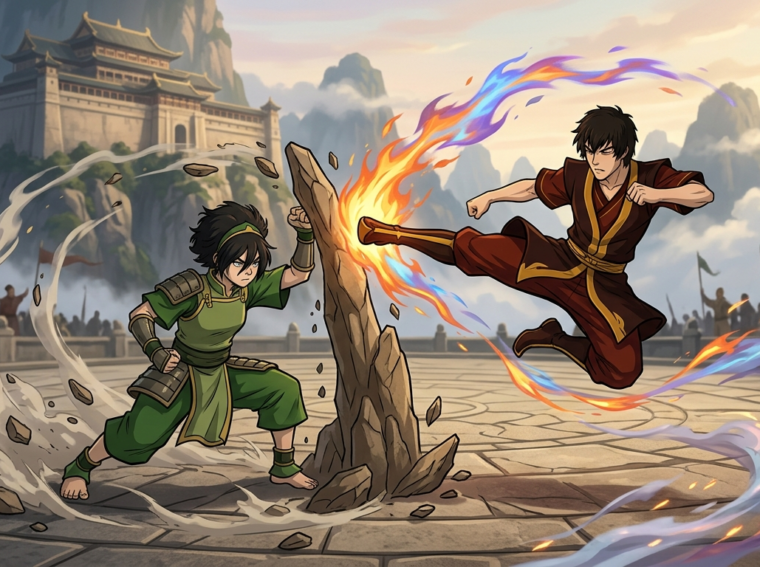
For years, Avatar: The Last Airbender fans have endured hit-or-miss video game adaptations that rarely captured the fluid weight and cinematic grace of martial arts bending. Avatar Legends: The Fighting Game changes that narrative entirely. Developed with obvious reverence for both the animated source material and classic 2D anime fighters, this title delivers a fast-paced, mechanically rich experience that caters to hardcore competitive players and franchise enthusiasts alike.
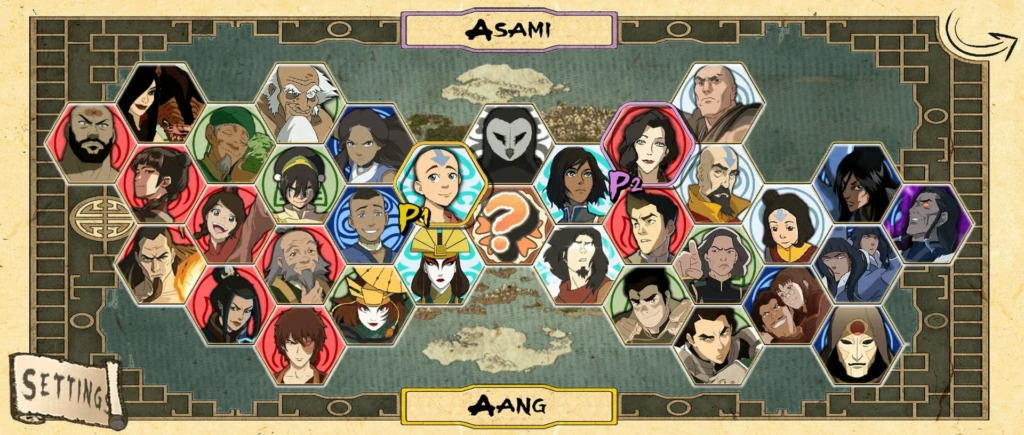
The character roster bridges generations across both Aang’s and Korra’s eras.. Source : games.gg
Gorgeous 2D Animation Faithful to the Show
From your very first match, the game’s presentation stands out. Rather than relying on rigid 3D models, Avatar Legends utilizes hand-drawn 2D character sprites and stages that look like an interactive episode of the TV series.
- Authentic Movement: Every character’s fighting style reflects their specific bending discipline—Aang glides lightly with airbending evasions, Toph strikes with grounded, heavy earthbending impact, and Zuko uses precise, disciplined firebending slashes.
- Visual Polish: Hits carry tangible weight, background stages are packed with series cameos, and dynamic ultimate animations deliver big-budget cinematic flare without slowing down match pacing.
Core Gameplay: Fast, Fluid, and Unforgiving
At its core, Avatar Legends operates as a 1v1, high-mobility fighter reminiscent of anime classics like Guilty Gear or Skullgirls. It relies on a four-button layout (Light, Medium, Heavy, and Special), making basic attacks approachable while hiding immense mechanical depth under the hood.
1. The Flow System
The signature mechanic driving every exchange is Flow. By expending Chi resources, players can activate Flow state to execute tight parries, spatial dodges, or rapid momentum cancels.
- High Risk, High Reward: Flow gives you an immediate “get-out-of-pressure” option, but holding it carelessly leaves you open to heavy counter-throws.
- Mobility Buffs: Canceling moves into Flow enables aggressive aerial re-positioning, allowing mobile characters to zip across the screen in milliseconds.
2. Support Character Synergies
Rather than traditional tag-team assists, Avatar Legends introduces a unique Support System. Before a match, you select a primary fighter and pair them with a secondary support character.
- Supports don’t just pop on screen for a quick attack—they actively alter your primary character’s move properties.
- Pairing Korra with specific supports can extend her Avatar state duration, unlock double jumps, or enhance specific bending follow-ups, creating dozens of distinct competitive match-up options from a 12-character base roster.
Training Tools & Single-Player Content
While the combat loop shines brightly, the single-player package presents a mixed bag for casual gamers.
| Feature | Execution Quality | Details |
| Online Netcode | Excellent | Rollback netcode provides seamless, lag-free matches with near-instant rematch loading times. |
| Combo Trials & Frame Data | Great | Includes step-by-step frame freeze (“Breakdown”) options and default frame data visualizers. |
| Story Campaign | Average | A lighthearted 27-chapter “multiverse” plot that feels like fanfiction; lacks AI difficulty sliders. |
| Lobby System | Limited | Launch lobbies are capped at 2 players (multi-player spectator lobbies slated for post-launch). |
Training Mode Highlight: The built-in “Breakdown” feature pauses combat at every single button input during combo tutorials, making complex multi-hit sequences far easier to commit to muscle memory.
The Verdict
Avatar Legends: The Fighting Game is an exceptional title that successfully bridges the gap between beloved pop-culture IP and serious fighting game mechanics. While its story campaign and multiplayer room sizes leave room for improvement, the core fighting design—anchored by lightning-fast rounds, creative combo freedom, and flawless netcode—makes it one of the most rewarding fighting games on the market.
Final Score: 8.5 / 10
6 Comments
benuabet
[690]Benuabet: Login Resmi Situs Slot Gacor dan Casino Deposit Pulsa,Benuabet menyediakan akses login resmi untuk main slot gacor. Nikmati kemudahan download apk dan deposit via pulsa untuk casino online. Daftar sekarang juga! visit: benuabet
peniti4d
[5468]peniti4d | Login Resmi Situs Slot Gacor Hari Ini Terpercaya,peniti4d menyediakan akses login resmi dengan opsi download APK praktis. Temukan pola slot Pragmatic Play terbaru dan cara deposit via Dana yang mudah. Daftar sekarang! visit: peniti4d
phtayacomlogin
This site has a really great community feeling. The bonuses for new members are actually generous and not just bait. Love phtayacomlogin!
99jlbetapp
The app is super snappy and doesn’t crash like other platforms I’ve used. Getting my wins out is a breeze here. Love using 99jlbetapp on my phone.
pkad7777
I love the bonuses they give to new players. It really helped me get started and build my balance. Big thanks to pkad7777 for the generosity.
betnacionaloficial
The variety of betting options here is insane. I can find everything I need in one place. Best choice is betnacionaloficial.