
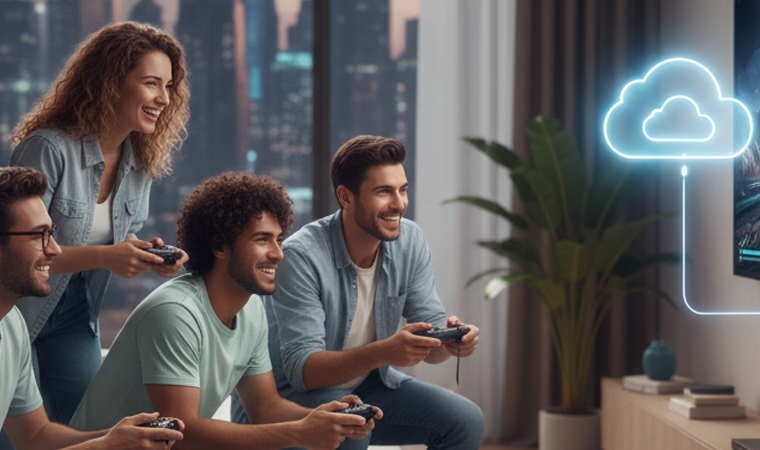
What Is Cloud Gaming and Why Does It Matter?
Imagine playing the latest AAA game on your phone during your lunch break, then seamlessly continuing on your TV at home, and finishing on your laptop in bed—all without owning a gaming console or expensive PC. Sound impossible? Welcome to cloud gaming, the technology that’s fundamentally reshaping how we think about video games. This isn’t science fiction or some distant future prediction—it’s happening right now, and it’s changing everything about gaming as we know it.
Cloud gaming, also called game streaming, works like Netflix but for video games. Instead of downloading massive files or inserting physical discs, games run on powerful remote servers. These servers do all the heavy computational lifting—processing graphics, physics, and game logic—then stream the video output to your device while sending your controller inputs back upstream. It’s like having a supercomputer in the cloud that you can access from virtually any screen with an internet connection.
Why does this matter so much? Because cloud gaming fundamentally democratizes gaming. The $500 console barrier? Gone. The $1,500 gaming PC requirement? Eliminated. The anxiety about whether your hardware can run the latest releases? Ancient history. In 2026, we’re witnessing the transformation of gaming from a hardware-dependent hobby into a software service accessible to anyone with decent internet. Let’s explore how this revolution is unfolding and what it means for gamers, developers, and the industry at large.
Understanding the Technology Behind Cloud Gaming
At its core, cloud gaming is deceptively simple conceptually but incredibly complex technically. Here’s what’s happening behind the scenes: when you press a button on your controller, that input signal travels through the internet to a data center that could be hundreds or thousands of miles away. The server receives your input, processes what should happen in the game (maybe your character jumps or shoots), renders the resulting frame, compresses that video, and streams it back to your device—all ideally within 30-50 milliseconds to feel responsive.
The magic lies in the compression algorithms and streaming technologies that make this possible. Modern video codecs like H.265 and AV1 compress game footage efficiently while maintaining visual quality. Adaptive bitrate streaming adjusts quality based on your connection, prioritizing smoothness over maximum fidelity when bandwidth fluctuates. Edge computing places servers geographically closer to players, reducing the physical distance data must travel and thereby minimizing latency.
What makes 2026 different from earlier cloud gaming attempts is the convergence of several technologies. Faster home internet (fiber and 5G), more efficient video compression, better prediction algorithms that anticipate player inputs, and strategically located data centers have collectively pushed cloud gaming from “interesting concept” to “genuinely playable” for many people.
The Shift from Hardware to Software
This represents a fundamental paradigm shift in gaming. For decades, gaming advancement meant better hardware—faster processors, more powerful graphics cards, increased memory. Console generations defined gaming eras. PC gamers built rigs and obsessed over specs. The entire gaming ecosystem revolved around hardware capabilities determining what experiences were possible.
Cloud gaming flips this model. Suddenly, the hardware in your hands becomes merely a display and input device. A five-year-old laptop can theoretically run the same games as the latest gaming PC because neither is actually running the games—the cloud is. This shift has profound implications for game design, publishing, and the entire economics of gaming.
Think about it like the transition from owning physical media to streaming services. Just as Spotify made your music collection accessible from any device without carrying CDs or managing storage, cloud gaming makes your game library accessible from any screen without physical hardware limitations. The software experience becomes paramount while the hardware becomes commoditized.
The Evolution of Cloud Gaming
Early Attempts and Failures
Cloud gaming isn’t new—it’s been attempted for over a decade with mixed results. OnLive launched in 2010 with massive ambition but ultimately failed, shutting down in 2015. The technology wasn’t ready, internet infrastructure couldn’t support it, and consumer acceptance wasn’t there. Gaikai, acquired by Sony and transformed into PlayStation Now, had similar struggles early on.
These failures weren’t because cloud gaming was a bad idea—they were premature implementations. The technology needed to catch up with the vision. Internet speeds weren’t fast enough. Latency was too high. Video compression wasn’t efficient enough. Data center infrastructure wasn’t geographically distributed. These pioneers proved the concept but couldn’t deliver the experience.
What’s changed? Everything. Average internet speeds have more than tripled since 2015. Fiber connections have become common in urban areas. Mobile 5G provides legitimate high-speed wireless. Cloud infrastructure has exploded with companies like Amazon, Microsoft, and Google building massive, globally distributed data centers. The technology finally matches the ambition.
Modern Success Stories
Today’s cloud gaming services succeed where predecessors failed. Xbox Cloud Gaming (formerly xCloud) launched officially in 2020 and has steadily improved. NVIDIA GeForce NOW provides surprisingly good performance. PlayStation Plus Premium streams a vast library of PlayStation classics. Amazon Luna carved out its niche. Shadow offers virtual gaming PCs.
What makes these services work is realistic expectations and smart implementation. They don’t promise zero latency or perfect fidelity—they deliver good enough experiences for most players most of the time. They’re transparent about internet requirements. They offer free trials so users can test their specific situations. They focus on games where slight latency is acceptable rather than trying to stream competitive fighting games.
The success isn’t universal—cloud gaming still has limitations and critics. But the trajectory is clear: it’s improving rapidly, gaining users, and becoming a legitimate way to play games for millions of people.
Best Cloud Gaming Services 2026
Xbox Cloud Gaming (Game Pass Ultimate)
Library and Performance
Xbox Cloud Gaming represents Microsoft’s massive bet on streaming’s future. Included with Game Pass Ultimate ($16.99/month), it provides access to hundreds of games streamable to phones, tablets, PCs, and even select Samsung TVs. The library is Xbox Cloud Gaming’s strongest asset—nearly every Game Pass title is available for streaming, including day-one releases of first-party Microsoft games.
Performance has improved dramatically since launch. Microsoft has upgraded servers to Xbox Series X hardware, providing better graphics and frame rates. The service targets 1080p60fps, which it achieves fairly consistently on good connections. The quality won’t match native Series X visually, but it’s surprisingly close—good enough that many players can’t tell the difference on smaller screens.
Platform Compatibility
Xbox Cloud Gaming’s versatility is remarkable. It works on iOS through web browsers (sidestepping Apple’s App Store restrictions), Android via native app, Windows PCs, and supported smart TVs. You can start playing on your phone, pause, and continue instantly on your laptop. This seamless cross-device experience is cloud gaming’s promise realized.
NVIDIA GeForce NOW
Bring Your Own Games Model
GeForce NOW takes a different approach—it doesn’t sell you games. Instead, it streams games you already own on platforms like Steam, Epic Games Store, and GOG. This “bring your own games” model appeals to PC gamers with existing libraries who want to play on devices that can’t normally run those games.
The service supports over 1,500 games (though not everything in your library—publisher opt-in is required). When a game you own is supported, you’re essentially renting cloud PC hardware to run it. This model respects game ownership in ways subscription services don’t.
Performance Tiers
GeForce NOW offers multiple tiers. The free tier provides hour-long sessions with standard access. Priority tier ($9.99/month) removes session limits and provides priority access to servers. Ultimate tier ($19.99/month) offers RTX 4080-powered gaming with ray tracing, DLSS 3, and 4K120fps streaming—the best visual quality available in cloud gaming.
The Ultimate tier genuinely impresses. If you have the bandwidth to support it, the visual quality rivals high-end local gaming. The technology NVIDIA has developed here is remarkable.
PlayStation Plus Premium
Sony’s cloud streaming tier of PlayStation Plus offers access to hundreds of PS4 and PS5 games plus a library of classic PS1, PS2, and PS3 titles. At $17.99/month (or cheaper with annual subscriptions), it’s competitively priced. The PS3 games are particularly noteworthy—since the PS3’s unique architecture makes backwards compatibility on modern hardware impossible, cloud streaming is the only way to play these classics on current PlayStation consoles.
Performance is decent though not quite matching Xbox Cloud Gaming in quality. Sony’s been doing this longer (PlayStation Now dates back to 2014) but has been slower to invest in infrastructure upgrades. Still, for PlayStation fans wanting access to legacy titles, it’s the only game in town.
Amazon Luna
Luna is Amazon’s entry into cloud gaming, leveraging AWS infrastructure. It uses a channel-based subscription model—you pay for specific publishers’ libraries rather than one massive catalog. The Ubisoft+ channel provides Ubisoft games, the Family channel offers family-friendly titles, etc. You can also purchase individual games.
Luna’s advantage is Amazon’s infrastructure—AWS data centers are everywhere, potentially providing good coverage. The disadvantage is the fragmented subscription model can get expensive if you want multiple channels. Luna works on Fire TV devices, making it a natural fit for Amazon’s ecosystem.
Shadow
Shadow is unique—it’s not a game streaming service per se, but rather cloud PC rental. You’re renting a full Windows 10 PC in the cloud with dedicated resources. This means you can install anything—Steam, Epic, emulators, mods, whatever. It’s your PC, just remotely accessed.
The flexibility is unmatched. The cost is higher ($29.99-39.99/month depending on configuration). Performance depends on which tier you choose. For users wanting complete control and flexibility, Shadow is worth considering despite the premium pricing.
Play Games Without a Console: The Accessibility Revolution
Gaming on Budget Devices
This is where cloud gaming truly shines. That old laptop gathering dust? It’s now a gaming machine. Your budget Android phone? It can run Cyberpunk 2077. Your parent’s iPad? Perfect for Halo Infinite. Cloud gaming transforms any device with a screen and internet connection into a potential gaming platform.
The implications for accessibility are enormous. Kids who can’t afford consoles can now game. College students with only laptops can access AAA titles. People in developing markets where gaming hardware is prohibitively expensive can participate. Cloud gaming doesn’t eliminate the hardware barrier entirely—you need some device and good internet—but it dramatically lowers it.
No More Hardware Upgrades
Remember the anxiety of PC gaming? Will my GPU run this new game? Do I need to upgrade? Can I afford it? Cloud gaming eliminates this entirely. The service upgrades the servers; you benefit automatically. When Microsoft upgraded Xbox Cloud Gaming servers from Xbox One S to Series X hardware, every user immediately got better performance without doing anything.
This also means no mid-generation obsolescence. Console generations last 6-8 years, but cloud services can upgrade continuously. Your experience improves over time rather than slowly deteriorating as hardware ages.
Instant Access to Games
No more waiting hours for downloads. No more managing storage space. No more deleting games to make room for new ones. With cloud gaming, you see a game that interests you, click play, and you’re in within seconds. This instant gratification fundamentally changes the gaming experience.
For subscription services, this enables Netflix-style browsing. Curious about a game but not sure if you’ll like it? Just try it. If it’s not for you, quit and try something else. No commitment beyond time. This encourages exploration and experimentation in ways that $60 purchases never could.
Cloud Gaming Advantages That Are Transforming Play
Eliminating Download Times
Modern games are massive. Call of Duty installations exceed 200GB. Red Dead Redemption 2 is over 150GB. On slower internet connections, downloading these games takes hours or days. Even on fast connections, you’re waiting. Cloud gaming makes this obsolete—the game is already installed and ready on the server.
This advantage extends to updates too. When a game patches, you don’t wait—the server updates, and next time you play, you’re on the latest version automatically. No more login queues while updates download. No more surprise maintenance ruining your planned gaming session.
Device Flexibility and Portability
The ability to play the same game across multiple devices without any configuration or transfer is magical. You’re playing on your PC at home, then you need to leave. Pull out your phone, launch the app, and continue from exactly where you left off. At a friend’s house? Use their laptop or TV. The game state lives in the cloud, accessible from anywhere.
This flexibility changes how and when we game. Suddenly, gaming isn’t confined to your gaming room or living room. It’s on your commute, during lunch breaks, while traveling. Gaming becomes a truly portable, ubiquitous entertainment option.
Try Before You Buy
Subscription services with cloud gaming enable risk-free game exploration. GamePass has hundreds of games—many you’ve never heard of. Without cloud gaming, trying unknown games means downloads and storage management. With cloud gaming, you click and play. If it’s not for you after five minutes, quit and try something else.
This discovery mechanism benefits both players and developers. Players find hidden gems they’d never have bought. Developers get exposure for games that would’ve been ignored. It’s a win-win that wouldn’t exist without instant-access cloud gaming.
Environmental Benefits
Here’s an angle rarely discussed: cloud gaming might be more environmentally friendly. Instead of millions of power-hungry consoles and PCs each running individually, cloud data centers use shared resources more efficiently. Data centers optimize cooling and power efficiency in ways individual homes can’t. While streaming does use more bandwidth (and thus network infrastructure energy), the overall equation might favor centralized cloud computing for many users.
The environmental argument shouldn’t be oversold—data centers still consume massive energy. But they’re at least potentially more efficient than distributed hardware, particularly for casual gamers who’d own underutilized hardware.
The Technical Challenges of Streaming Games
Internet Speed Requirements
Cloud gaming’s Achilles heel is internet requirements. You need consistent, fast connections—minimum 15-20 Mbps for 720p, 30-40 Mbps for 1080p, 50+ Mbps for 4K. That’s downstream. Upstream requirements are lower but still significant for input responsiveness.
Many households meet these requirements, but many don’t. In rural areas, developing countries, or places with poor internet infrastructure, cloud gaming simply doesn’t work. This creates a digital divide where cloud gaming’s accessibility only applies if you’re already privileged enough to have fast internet.
Latency and Input Lag
Latency—the delay between pressing a button and seeing the result—is cloud gaming’s technical challenge. Even perfect implementations add 30-50ms compared to local gaming. For many games, this is imperceptible. For competitive shooters, fighting games, or rhythm games, it’s unacceptable.
Services have improved latency dramatically through edge computing, predictive algorithms, and better protocols. But physics remains physics—data traveling hundreds of miles takes time. Cloud gaming will probably never match local gaming’s responsiveness for latency-critical games.
Data Usage Concerns
Streaming games uses tremendous data—2-10GB per hour depending on quality. For users with data caps (common in many regions), this is prohibitive. A few hours of daily gaming could easily consume a monthly data allowance.
Unlimited internet is becoming more common, but where caps exist, cloud gaming’s data requirements are a significant barrier. Users need to factor data costs into the value proposition.
Video Quality Compromises
Despite improvements, streamed games never quite match local rendering. Compression artifacts, reduced color depth, and lower bitrates are necessary to fit games through internet connections. On large screens with discerning eyes, the difference is noticeable.
However, on smaller screens (phones, tablets) or at typical viewing distances, most people can’t tell. The compromise is acceptable for convenience. As compression technology improves and bandwidth increases, this gap will continue narrowing.
How Cloud Gaming Changes Game Development
Lower Barriers for Indie Developers
Cloud gaming potentially helps indie developers by removing hardware as a barrier for their audience. If your game is on a cloud service, everyone with a subscription can play it regardless of their device. This expands potential audiences significantly.
Additionally, cloud infrastructure simplifies server hosting for multiplayer games. Instead of indie developers managing server infrastructure, the cloud gaming service handles it. This reduces technical overhead and costs.
Cross-Platform Development Simplified
Cloud gaming abstracts away some platform differences. Develop once for the cloud infrastructure, and it works on all devices accessing that cloud. This doesn’t eliminate all cross-platform challenges, but it reduces them compared to developing native versions for PC, Xbox, PlayStation, Nintendo Switch, and mobile separately.
Always-Updated Games
With cloud gaming, players always run the latest version. Developers can push updates instantly without waiting for certification or worrying about version fragmentation. This enables more iterative development—release updates frequently, respond to feedback quickly, fix bugs immediately.
This changes the development cycle from discrete releases to continuous improvement. It’s more similar to web development than traditional game development—always live, always updating.
The Business Model Revolution
Subscription Services Dominating
Cloud gaming has accelerated gaming’s transition to subscription models. Why buy individual games when Game Pass provides hundreds for a monthly fee? This Netflix-ification of gaming changes everything about economics.
For users, subscriptions provide tremendous value—more games than you can play for less than one AAA purchase costs. For publishers, it provides predictable recurring revenue rather than volatile launch windows. For developers, it’s complicated—they’re paid by the subscription service rather than individual sales, changing incentive structures.
Reduced Piracy
Streaming games by nature prevents piracy. You can’t pirate what you don’t download. The server-side execution means game files never reach users’ devices. While piracy will never disappear (screen recording and other workarounds exist), cloud gaming dramatically reduces it for the games streamed this way.
This benefits developers but raises questions about game preservation. If games only exist on streaming servers, what happens when services shut down?
New Revenue Streams for Developers
Cloud services compensate developers through various models—per-hour played, per-user engagement, lump sum licensing fees. These models differ from traditional sales, potentially benefiting games with strong retention over those with strong launch marketing.
Subscription models might favor certain game types—endless replayability, live service games, or broad-appeal titles—over niche or shorter experiences. This could subtly influence what games get made.
Cloud Gaming’s Impact on Traditional Gaming Hardware
Console Manufacturers Adapting
Microsoft and Sony have responded differently to cloud gaming. Microsoft embraced it fully, positioning Xbox as a service rather than just a console. Xbox hardware is now optional—you can be an Xbox gamer without an Xbox. This bold strategy essentially cannibalizes their hardware business to build their service business.
Sony has been more conservative, treating cloud gaming as supplementary rather than primary. PlayStation consoles remain central to Sony’s strategy, with cloud gaming as an additional option for subscribers.
Nintendo has ignored cloud gaming almost entirely (except for a few experiments streaming specific games in Japan). Their focus remains on unique hardware experiences—the Switch’s hybrid nature provides portability that cloud gaming on generic devices can’t replicate yet.
The Decline of High-End Gaming PCs?
PC gaming has thrived on pushing graphical boundaries. Enthusiasts build expensive rigs to run games at maximum settings. Does cloud gaming threaten this market?
Not really—at least not yet. Enthusiast PC gamers value the experience of building, customizing, and controlling their hardware. They want absolute maximum performance and fidelity. Cloud gaming doesn’t satisfy these desires.
However, for the mainstream PC gamer who just wants to play games, cloud gaming offers an attractive alternative to expensive hardware. The mid-range PC gaming market might erode as cloud gaming improves.
Controller Market Evolution
Interestingly, cloud gaming has created a boom in third-party controller sales. Since you need a controller to play cloud games on phones or tablets, companies like Backbone, Razer, and 8BitDo have released mobile gaming controllers. This hardware market exists specifically because of cloud gaming.
Regional Differences and Infrastructure
5G Enabling Mobile Cloud Gaming
5G networks with their low latency and high bandwidth make mobile cloud gaming viable. In regions with strong 5G deployment, playing console-quality games on phones while commuting is genuinely practical. South Korea and parts of China have particularly embraced mobile cloud gaming enabled by ubiquitous 5G.
However, 5G deployment is wildly uneven globally. Rich countries get it faster; rural areas lag behind; developing nations may wait years or decades for widespread coverage.
Urban vs. Rural Divide
The digital divide manifests clearly in cloud gaming. Urban areas with fiber optic internet get great experiences. Rural areas with DSL or satellite connections can’t use cloud gaming effectively. This creates a situation where cloud gaming’s accessibility only extends to those already privileged with good infrastructure.
Global Rollout Challenges
Cloud gaming services roll out unevenly. Some regions have multiple competing services; others have none. Licensing complexities, infrastructure costs, and regulatory hurdles create patchwork availability. A gamer in California has radically different cloud gaming options than someone in rural India or Brazil.
The Social and Cultural Impact
Gaming Becoming More Inclusive
By lowering hardware barriers, cloud gaming potentially makes gaming more inclusive. More people can participate regardless of economic status (assuming they have decent internet). This could diversify gaming demographics and cultures.
Changing Player Demographics
Cloud gaming attracts casual players who’d never buy dedicated hardware. These players expand gaming demographics beyond the traditional “gamer” identity. This broader audience influences what games get made and how they’re designed.
The Rise of Casual Gaming
The accessibility of cloud gaming particularly benefits casual gaming. Hardcore gamers might still prefer dedicated hardware, but casual players increasingly access games through subscription services on devices they already own.
Security and Ownership Concerns
Digital Rights and Game Ownership
Cloud gaming accelerates the shift from ownership to licensing. You don’t own cloud games—you access them as long as you subscribe. When subscriptions end or services shut down, access disappears. This raises legitimate concerns about digital rights and long-term game access.
Account Security
Cloud gaming accounts become single points of failure for entire game libraries. Account security becomes critical when your entire gaming depends on service accounts rather than physical media or downloaded games.
Server Shutdowns and Game Preservation
What happens to games that only exist on cloud services when those services shut down? Traditional games can be preserved through archiving, emulation, and physical media. Cloud-only games vanish completely when servers close. This threatens gaming history and preservation.
The Future of Cloud Gaming
AI and Machine Learning Integration
AI could significantly improve cloud gaming through predictive rendering, intelligent streaming optimization, and better input prediction. Machine learning might reduce perceived latency by predicting player actions and pre-rendering likely outcomes.
VR and AR Cloud Gaming
Cloud-rendered VR is particularly challenging due to the extreme latency sensitivity and bandwidth requirements. But if solved, it would enable VR experiences on standalone headsets without processing limitations. This remains years away technically.
Predictions for the Next Decade
Cloud gaming will continue growing but probably won’t completely replace traditional gaming within the next decade. It’ll coexist with local gaming, serving different needs and preferences. Technology will improve dramatically—lower latency, better quality, wider availability. But ultimate success depends on infrastructure improvements globally.
Is Cloud Gaming Right for You?
Assessing Your Internet Connection
Before diving into cloud gaming, honestly assess your internet. Run speed tests. Check for data caps. Test stability over time. If your connection is fast and stable, cloud gaming will likely work well. If it’s inconsistent or limited, you’ll be frustrated.
Gaming Preferences and Playstyle
Your gaming preferences matter. Casual gamers playing story-driven games will have great experiences. Competitive gamers playing twitchy shooters or fighting games will notice latency. Match your expectations to your playstyle.
Budget Considerations
Cloud gaming subscriptions seem cheap monthly but add up annually. Compare subscription costs against traditional game purchases for your playing habits. Factor in internet costs and potential upgrades. Do the math for your situation.
Conclusion
Cloud gaming isn’t just changing the gaming industry—it’s fundamentally transforming it. The best cloud gaming services 2026 offers prove that you can genuinely play games without a console, eliminating hardware barriers that have defined gaming for decades. The cloud gaming advantages are real: instant access, device flexibility, no downloads, and accessibility that extends gaming to anyone with good internet.
But challenges remain. Latency issues persist, internet requirements exclude many, and ownership concerns are legitimate. Cloud gaming works brilliantly for some games and some players while remaining imperfect for others. It’s not replacing traditional gaming—it’s becoming an essential alternative that coexists with local gaming.
The revolution is here, but it’s nuanced. Cloud gaming has proven itself as a legitimate way to play games, finally delivering on promises made over a decade ago. As technology improves and infrastructure expands, cloud gaming will only become more viable for more people. Whether you embrace it now or wait for further maturation, understanding how cloud gaming is reshaping the industry helps you navigate gaming’s evolving landscape.
The future of gaming isn’t purely in the cloud, but the cloud is undeniably part of gaming’s future. For millions of players, that future has already arrived, and they’re gaming in ways previously impossible. That’s not just changing the industry—that’s redefining what gaming can be.
FAQs
1. What are the best cloud gaming services in 2026 and which should I choose?
The best cloud gaming services in 2026 each excel in different ways. Xbox Cloud Gaming (included with Game Pass Ultimate at $16.99/month) offers the best value with hundreds of games including day-one Microsoft releases, working across phones, tablets, PCs, and smart TVs. NVIDIA GeForce NOW provides the best performance, especially the Ultimate tier ($19.99/month) with RTX 4080-powered 4K gaming, but requires you to own games separately. PlayStation Plus Premium ($17.99/month) is essential for PlayStation fans wanting classic PS1-PS3 games. Amazon Luna works well within Amazon’s ecosystem but has a fragmented subscription model. Shadow ($29.99-39.99/month) offers complete flexibility as a full cloud PC but costs more. Choose based on your needs: Game Pass for value and variety, GeForce NOW for performance and existing PC libraries, PlayStation for Sony exclusives, Luna for Amazon integration, or Shadow for flexibility.
2. Can you really play games without a console using cloud gaming, or is the quality terrible?
Yes, you genuinely can play AAA games without a console through cloud gaming, and the quality is surprisingly good—but with important caveats. On a stable, fast internet connection (30+ Mbps), cloud gaming delivers 1080p60fps that looks great on most screens, especially phones and tablets where compression artifacts are less noticeable. The experience rivals local gaming for many game types—RPGs, adventure games, strategy titles, and single-player experiences work excellently. However, competitive multiplayer games with tight timing (fighting games, competitive shooters) show noticeable input latency that bothers skilled players. Visual quality on large screens with discerning viewers reveals compression artifacts that native rendering doesn’t have. But for most players playing most games, cloud gaming quality is absolutely acceptable and sometimes indistinguishable from local gaming. Try free trials to test with your specific setup.
3. What are the main cloud gaming advantages and disadvantages I should know about?
Cloud gaming advantages: No expensive hardware needed—play on phones, tablets, old laptops. No downloads or installs—instant access to games. No storage management or updates to wait for. Device flexibility—play the same game across multiple devices seamlessly. Try games risk-free through subscriptions. No hardware becomes obsolete. Better environmental efficiency potentially. Lower barrier to entry for new gamers. Disadvantages: Requires fast, stable internet (30+ Mbps minimum)—doesn’t work well in rural areas or with poor connections. Noticeable input latency in competitive games. High data usage (2-10GB/hour) problematic with data caps. Video quality never quite matches native rendering. You don’t own games—access depends on active subscriptions. Game availability depends on licensing. Can’t mod games. Some games aren’t available. Offline play impossible. Services can shut down, taking games with them.
4. What internet speed do I need for cloud gaming, and will it work with my connection?
Minimum internet requirements for cloud gaming: 720p/30fps requires 10-15 Mbps; 1080p/30fps requires 15-25 Mbps; 1080p/60fps requires 25-40 Mbps; 4K/60fps requires 50-80+ Mbps. However, minimum speeds aren’t enough—you need stable connections without frequent packet loss or jitter. Wired ethernet connections work better than WiFi. Test your connection during peak hours when you’d actually play. Latency matters as much as bandwidth—ping under 50ms is ideal, 50-80ms is acceptable, over 100ms causes noticeable lag. Data caps are critical—cloud gaming uses 2-10GB/hour, so unlimited internet is practically mandatory. Most services offer free trials or testing tools—use them to verify your specific connection works. If you’re in a rural area, have inconsistent internet, or face data caps, cloud gaming will likely frustrate you. Urban fiber or 5G connections typically work well.
5. Will cloud gaming replace traditional consoles and gaming PCs, or will they coexist?
Cloud gaming will coexist with traditional gaming rather than replace it completely, at least for the next decade. Different gaming needs favor different approaches. Cloud gaming excels for: casual players, budget-conscious gamers, people wanting device flexibility, instant access without downloads, trying games through subscriptions, and playing while traveling. Traditional hardware excels for: competitive gamers needing minimum latency, enthusiasts wanting maximum fidelity, players with poor internet, those preferring game ownership, modding communities, and offline play. The industry is moving toward hybrid models—Microsoft offers both Xbox consoles and cloud gaming; players can choose based on situations. Many gamers will use both—consoles at home, cloud while traveling. Console and PC sales remain strong despite cloud gaming growth, suggesting coexistence rather than replacement. However, cloud gaming’s share will grow as technology improves and younger generations embrace it. Traditional gaming isn’t disappearing, but it’s no longer the only option.
5 Comments
bilucky
[163]bilucky | Link Vào Mới Nhất – Hướng Dẫn Chơi Baccarat Online,bilucky cung cấp link vào mới nhất, hỗ trợ tải app chính thức nhanh chóng cùng hướng dẫn nạp tiền qua Momo tiện lợi. Khám phá luật chơi tài xỉu chi tiết tại đây. visit: bilucky
joker8
[3703]Joker8 | Link Vào Chính Thức – Tải App Và Chơi Slot Game Uy Tín,joker8 cung cấp link vào chính thức an toàn. Tải app APK dễ dàng, nạp tiền casino nhanh chóng và tìm hiểu luật chơi slot game chi tiết. Tham gia trải nghiệm ngay! visit: joker8
sbotopapk
The app version is so much better than the mobile site. Fast access and great layout. Check out sbotopapk
8kbetvvip
The VIP perks here are actually worth it. I feel like a valued player every time I log in. Join the club at 8kbetvvip.
auronplaycasino
Great experience so far. The customer support is actually helpful and doesn’t just give canned responses. Love the energy at auronplaycasino.